
Blog
Types of Chikankari Stitches: Shadow, Jaali, Tepchi, Bakhiya and More

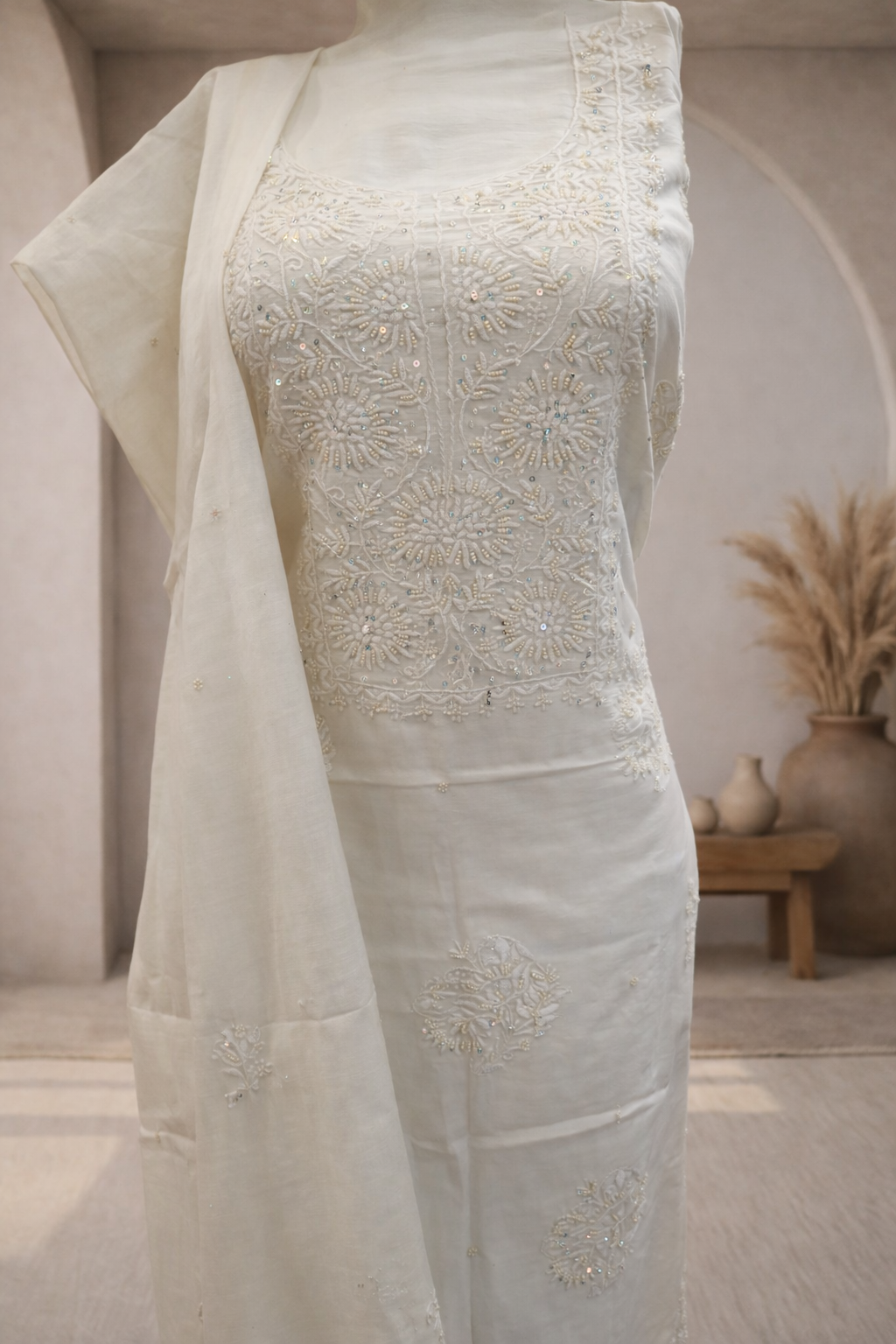
One of the pleasures of owning chikankari is looking closely at the stitching. Unlike printed motifs, chikankari is built from a vocabulary of distinct stitches, each with its own texture. Learning to recognise the main types of chikankari stitches helps you appreciate a garment and judge the care that went into it. Here is a practical guide.
How chikankari stitches are grouped
Traditional descriptions often say there are dozens of chikankari stitches, and different artisans and books count them differently. For simplicity, they are usually sorted into three families:
- Flat stitches that lie close to the fabric surface.
- Raised or knotted stitches that add small bumps of texture.
- Jaali or net stitches that open up the weave of the fabric itself.
Most garments use a mix of these. You rarely see just one stitch on a piece.
Flat stitches
Tepchi
Tepchi is a long, loose running stitch worked on the front of the fabric. It is one of the simplest stitches and often forms the outline or stem of a design. If you see a long, even line of thread along a vine or leaf, it is likely tepchi.
Bakhiya (shadow work)
Bakhiya, often called shadow work, is stitched on the reverse of the fabric. The thread crosses back and forth behind a sheer fabric, so from the front you see a soft, shaded motif rather than a bold line. It works best on light, semi-sheer cloth such as georgette or fine cotton, which is why it features strongly on chikankari sarees.
There is also a related stitch called ulta bakhiya, where the technique is reversed. Both create a delicate, shadowy impression.
Khatau and other fillers
Some flat stitches are used to fill petals or leaves with fine, neat lines. The effect is smooth, almost like a drawn shape.
Raised and knotted stitches
Murri
Murri is a tiny stitch with a slightly elongated, rice-grain shape. It is often used at the centre of flowers. When you run a finger over it, you can feel a small bump.
Phanda
Phanda is a small, rounded knot, often described as millet-like. Rows of phanda are used for flower centres or buds and add dotted texture.
Gol murri and other variations
Variations in size and shape create different effects, and experienced artisans choose them according to the motif.
Jaali stitches
Jaali means net or lattice. In jaali work, the embroiderer draws the fabric threads apart and stitches around the tiny gaps, forming an open mesh. Because the effect comes from the fabric rather than from added thread, it feels light and lace-like. Jaali is popular in yokes, sleeves and borders, where a see-through detail adds interest.
Other stitches you may hear about
- Hool: a small eyelet-like hole, often used in flower centres.
- Keel and kangan: tiny decorative details that add finishing touches.
- Chane ki patti: a leaf-shaped stitch resembling a gram leaf.
Different workshops use slightly different names, so do not be surprised if terms vary.
How the stitches combine in one design
A typical flower might use murri at the centre, tepchi for the stem, bakhiya for the petals and jaali for a decorative detail beside it. This layering is part of what makes good chikankari look rich while still being subtle.
Chikankari with other embellishments
Modern chikankari often adds other details such as pearls, cut dana or mukaish metal work. For example, this chikankari anarkali with cut dana and pearl work combines classic embroidery with sparkle, and this mulchanderi kurta and dupatta with mukaish embroidery uses mukaish dots. Our mukaish work guide explains that craft in detail.
How to look at a garment closely
You do not need expert knowledge to check quality. Try this simple routine:
- Turn the garment inside out. Neat, tidy stitching with few loose threads is a good sign.
- Look for consistency in stitch size across a motif.
- Check that the shadow work looks soft and even rather than patchy.
- Feel the knotted stitches to see that they are firm and not loose.
For a deeper checklist, read our guide on identifying handmade chikankari.
Explore chikankari at Lucknowiada
You can browse chikankari suits, anarkalis and more in our shop. If you live near Delhi, you are welcome to see the stitching in person at our store at 1374 Maliwara, Nai Sarak, Chandni Chowk, open Monday to Saturday, 11:00 to 18:00.
Frequently asked questions
How many types of chikankari stitches are there?
Counts vary. Traditional sources mention dozens, grouped into flat, raised and jaali stitches. Different artisans use different names for similar stitches.
What is shadow work in chikankari?
Shadow work, or bakhiya, is stitched on the back of a sheer fabric so the motif appears as a soft shadow on the front.
What is the difference between jaali and other stitches?
Jaali creates an open net by spreading the fabric threads apart, while most other stitches add thread on top of the fabric.
Which stitch is easiest to recognise?
Tepchi, the long running stitch, and the small raised knots of murri and phanda are usually easiest for beginners to spot.
